
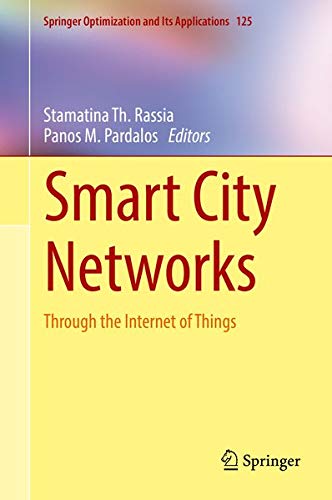
Smart City Networks [electronic resource] : Through the Internet of Things / edited by Stamatina Th. Rassia, Panos M. Pardalos.
Material type: TextSeries: Springer Optimization and Its Applications ; 125Publisher: Cham : Springer International Publishing : Imprint: Springer, 2017Edition: 1st ed. 2017Description: X, 227 p. 78 illus., 66 illus. in color. online resourceContent type:
 - text
- computer
- online resource
- 9783319613130
- 519.6 23
- QA402.5-402.6
| Cover image | Item type | Current library | Home library | Collection | Shelving location | Call number | Materials specified | Vol info | URL | Copy number | Status | Notes | Date due | Barcode | Item holds | Item hold queue priority | Course reserves | |
|---|---|---|---|---|---|---|---|---|---|---|---|---|---|---|---|---|---|---|
 e-Books
|
Central Library, Sikkim University | 519.6 (Browse shelf(Opens below)) | Not for loan | E-3115 |
Designing Access to Nature for Residential Buildings -- Virtual Reality and Augmented Reality Enabled IoT for the Building Industry -- Asia’s Cities – Necessity, Challenges & Solutions for Going “SMART” -- Development of Smart Cities from Fiction to Reality in Member States of the Gulf Cooperation Council -- Smart Cities: Distributed Intelligence or Central Planning? -- Wireless Protocols for Smart Cities -- Leveraging Smart City Projects for Benefitting Citizens: The Role of ICTs -- Energy Consumption of the Building Sector: Incorporating Urbanization, Local Climate Change and Energy Poverty -- Systems Science Simulation Modeling to Inform Urban Health Policy and Planning -- Smart Cities IoT: Enablers and Technology Roadmap -- Cities as Visuospatial Networks -- Hidden Geometry of Urban Landscapes for Smart City Planners.
This book both analyzes and synthesizes new cutting-edge theories and methods for future design implementations in smart cities through interdisciplinary synergizing of architecture, technology, and the Internet of Things (IoT). Implementation of IoT enables the collection and data exchange of objects embedded with electronics, software, sensors, and network connectivity. Recently IoT practices have moved into uniquely identifiable objects that are able to transfer data directly into networks. This book features new technologically advanced ideas, highlighting properties of smart future city networks. Chapter contributors include theorists, computer scientists, mathematicians, and interdisciplinary planners, who currently work on identifying theories, essential elements, and practices where the IoT can impact the formation of smart cities and sustainability via optimization, network analyses, data mining, mathematical modeling and engineering. Moreover, this book includes research-based theories and real world practices aimed toward graduate researchers, experts, practitioners and the general public interested in architecture, engineering, mathematical modeling, industrial design, computer science technologies, and related fields.
There are no comments on this title.