
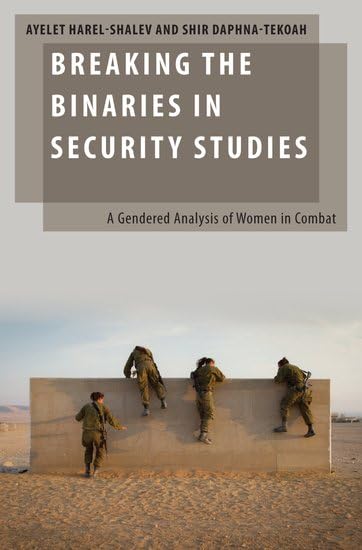
Breaking the Binaries in Security Studies: A Gendered Analysis of Women in Combat
Material type: TextSeries: Oxford studies in gender and international relationsCopyright date: ©2020Description: viii, 153pISBN:
 - 9780190072582
- 355.0082 SHA/B
| Cover image | Item type | Current library | Home library | Collection | Shelving location | Call number | Materials specified | Vol info | URL | Copy number | Status | Notes | Date due | Barcode | Item holds | Item hold queue priority | Course reserves | |
|---|---|---|---|---|---|---|---|---|---|---|---|---|---|---|---|---|---|---|
 General Books
|
Central Library, Sikkim University (Yangang Campus) General Book Section | 355.0082 SHA/B (Browse shelf(Opens below)) | C1 | Available | 053765 | |||||||||||||
|
General Books
|
Central Library, Sikkim University (Yangang Campus) General Book Section | 355.0082 SHA/B (Browse shelf(Opens below)) | C2 | Available | 053766 |
1.Women in Combat : A Gender Prospective
2. Violent State Actors in Feminist Research and Critical Studies
3. Listening to Narrative of Security and Insecurity
4. The Politics of trauma, Gender and War
Several months after a 2014 operation in the Gaza Strip, fifty-three Israeli Defense Forces combatants and combat-support soldiers were awarded military decorations for exhibiting extraordinary bravery. From a gendered perspective, the most noteworthy aspect of these awards was not the fact that only 4 of the 53 recipients were women, but rather the fact that the men were uniformly praised for being "brave," being "heroes," "actively performing acts of bravery," "protecting," and "preventing terror attacks," while the women were repeatedly commended for "not panicking." This pattern is not unique to the Israeli case, but rather reflects the patriarchal norms that still prevail in military institutions worldwide. One might expect that, now that women serve on the battlefield as combatants, some of the gendered norms informing militaries would have long disappeared. As it stands, women in the military still face a double battle-against the patriarchal institution, as well as against the military's purported enemies. drawing on interviews with 100 women military veterans about their experiences in combat, this book asks what insights are gained when we take women's experiences in war as our starting point instead of treating them as "add-ons" to more fundamental or mainstream levels of analysis, and what importance these experiences hold for an analysis of violence and for security studies. Importantly, the authors introduce a theoretical framework in critical security studies for understanding (vis-a-vis binary deconstructions of the terms used in these fields) the integration of women soldiers into combat and combat-support roles, as well as the challenges they face.
There are no comments on this title.